




Dr. Pinaki Roy ::: To stir the inquisitive mind of Bengali youths of pre-independent India, the rebel poet Kazi Nazrul Islam in his poem “Sankalpa” wrote few lines that were indeed many folds advance in his thought process with reference to the contemporary scientific research. Apart from the political background of the then world, those lines are very much in consistence with the geological exploration that were being carried out all over the world,especially in India. Those lines literary mean “how does the wealth unearth from the underground rocks? (Kemon kore mothle pathor laxmi uthen patal fure? )” – and the underlying meaning is that the layers of rocks that were formed through ages, enriched with ore minerals; and exploitation of those minerals indeed bring enormous wealth. Imprints of exploitation of ore and its uses have already been encountered at the very beginning of human civilization and so we have copper period and iron period after the neolithic age. The technological advancement not only aided the geological exploration but also in mines development. Widespread geological exploration brought forth various types of ore bodies and among them discovery of coal and petroleum that are most useful as fuel, worth mentioning.Two most ground-breaking discoveries in the history of human civilization were uses of fire and wheel; and to run a wheel what is mostly needed is the energy which is being resourced from fire. Heat energy is being converted into mechanical energy. But how could this uninterrupted supply of energy be fulfilled. Necessity is the father of invention and that leads to geological investigation in search of fuel.Geologists succeeded in discovering huge reserve of coal and petroleum in different parts of the world and India was not an exception.
It has already been an established fact that our planet earth is about 4500 million years old, though in comparison, the coal and petroleum bearing rocks are very much younger in age according to the geological time scale. The geological age of the earliest coal bearing rocks is 360 million years (Ma) during Carboniferous period. Both coal and petroleum are found to be formed in sedimentary rocks from the remains of dead plants and animals respectively under favourable pressure and temperature conditions prevailing at that time. Though the traces of life in the history of earth date back to 3600 million years before present, life forms in its full vigour came into being just about 542 million years ago (during Cambrian period), passing through perplexing patterns of evolution and diversification. Diversified forms of life have been encountered in rock records as fossils from this period. According to the time of formation and maturity, the coal bearing formations of the world has been classified into two Coal Era: Coal Era one extends from Carboniferous to Jurassic period (358.9 Ma to 145.5 Ma) and Coal Era two, extends from Cretaceous to Neogene period (145.5 Ma to 2.6 Ma). Coals of Era one are the higher rank anthracite and bituminous coal with higher calorific value and lesser amount of volatile content; on the other hand, coals of Coal Era 2 are having higher amount of volatile content giving rise to low calorific value. Coals from both of those eras are available in India; though most of the coal exploitation since pre-independent times, have been made from the Gondwana deposits belonging to coal era one, found to be occurred in and around the Damodar, Sone-Narmada and Mahanadi valley of West Bengal, Bihar (Presently Jharkhand & Bihar), Madhya Pradesh and Odhisa respectively.

The quality of coal is determined by its rank. The rank of a coal indicates the progressive changes in carbon, volatile matter, and probably ash and sulfur that take place as coalification progresses from the lower-rank lignite through the higher ranks of subbituminous, high-volatile bituminous, low-volatile bituminous, and anthracite. The rank of a coal should not be confused with its grade. A high rank (e.g., anthracite) represents coal from a deposit that has undergone the greatest degree of devolatilization and contains very little mineral matter, ash, and moisture. On the other hand, any rank of coal, when cleaned of impurities through coal preparation, will be of a higher grade. When vegetal matter containing carbon, hydrogen, oxygen, sulfur and other inorganic components decays under water, in the absence of oxygen, the carbon content increases. The initial product of this decomposition process is known as peat. Peat can be formed in bogs, marshes, or freshwater swamps, and in fact huge freshwater swamps of the geologic past provided favourable conditions for the formation of thick peat deposits that over time became coal deposits. The conversion of peat to lignite is the result of pressure exerted by sedimentary materials that accumulate over the peat deposits. Even greater pressures and heat from movements of Earth’s crust (during mountain building), and occasionally from igneous intrusion, cause the transformation of lignite to bituminous and anthracite coal.
Recently the Geological Survey of India has reported a huge deposit of coal in the Birbhum district of West Bengal located in Deocha-Pachami (Fig. 1) area and it is a part of Gondwana coal. According to the news report, the Government of West Bengal has made a probable estimation that amount to be 1200 lakh tonne. Mother nature as always concealed this coal reserve for such a long period from the reach of human by a covering of thick basaltic layer which is known as the Rajmahal trap. Hence it is a challenging job for the Geological Survey of India to explore and discover this coal deposit. Rajmahal trap is primarily a basaltic rock that originated through volcanic lava flows. It is indeed a herculean job to execute an exploratory drilling through such hard rock like basalt to reach the coal bearing rocks of the Barakar Formation lying under neath. The rock type in association to coal seams is mainly sandstone, gray carbonaceous shale and siltstone. Coal bearing rocks of the Barakar Formation [290 to 250 Ma, Permian period] has been encountered at a depth of 100-120 m below the surface and it is extended in 5200 sq. km. area of south-western part of the Birbhum district. In general, an open cast mining operation can be carried out, if the coal seam encountered up to about 300 m depth below the surface. So, in Deoach-Pachami area it is likely to be an open cast mining in operation. Basaltic rock is primarily useful as building material. Though it is over burden for the coal to be mined, it also has economic viability which government might have been taken into consideration.
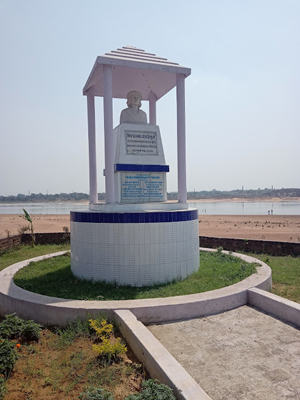
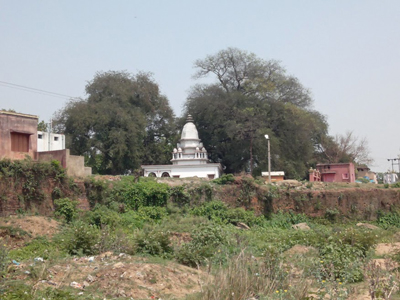
History of coal mining in India and specifically in the Bengal was started in the year of 1774 under the entrepreneurship of M/s Summer and Heatly and manual mining of coal began in the Damodar Valley region which was at that time covered with dense forest populated with tribal peoples. Later on another concern known as Alexander and Co. carried out coal mining operation for quite some time and finally the first Indian entrepreneur started mining operation in the year 1835 as Car and Tagore Co. which was launched by Prince Dwarakanath Tagore. At that time there was no rail connection between Raniganj and Kolkata and transportation of coals to Kolkata was carried out following water ways of the Damodar River. An age-old ruin of jetty is still there (Fig. 2) just at the north bank of Damodar River near a coal mine which is believed to be the same mine that was belonged to Prince Dwarakanath Tagore and the mines presently known as Narayan Kuri Coal Mines. Visitors can see a bust of Prince Dwarakanath Tagore (Fig. 3) which has recently been built there and it is bearing the signature of Bengal’s pride of past era. Recent Coal finds of Birbhum might be a silverline of regaining that pride in near future.
Dr. Pinaki Roy, Durgapur Government College,